Tab. V · Rubedo

the reddening · completion, the outward journey

Port of Mars

Port of Mars

Port of Mars

Port of Mars: a rover crosses a Martian plain beneath a towering mesa as a dust storm rolls in

Rehearse the future

Rehearse the future

Some of the hardest problems in human space exploration aren’t technological. They’re social.

Some of the hardest problems in human space exploration aren’t technological. They’re social.

Imagine the first human community on Mars: extreme isolation, limited resources, a lifeless, alien world that wants to kill everyone. The nearest help is at least 34 million miles away. How do you sustain a healthy community under such conditions?

Imagine the first human community on Mars: extreme isolation, limited resources, a lifeless, alien world that wants to kill everyone. The nearest help is at least 34 million miles away. How do you sustain a healthy community under such conditions?

Port of Mars is a social science experiment cosplaying as a game. Five players take on the roles of the first Martians. Each must balance personal ambition against caring for the habitat that keeps everyone alive. The player with the most points wins, but if the community fails, everyone dies.

No one wins if everyone’s dead.

No one wins if everyone’s dead.

The Politician, in a green flight suit with a gold sash, waving

The Politician

The Politician

The Pioneer, in an orange-harnessed spacesuit, gesturing

The Pioneer

The Pioneer

The Entrepreneur, in a long coat beside a holographic display

The Entrepreneur

The Entrepreneur

The Researcher, studying a glowing tablet

The Researcher

The Researcher

The Curator, an older man in a tailored suit, leaning on a cane

The Curator

The Curator

At its core is a research question: How can people effectively navigate dilemmas of shared resources and collective action under conditions of high uncertainty and high risk? Researchers call these social dilemmas: everyone benefits if everyone pitches in, but pitching in costs each person something. Some will choose not to pay it. Every player’s action is recorded and analyzed. Each game is a simulation, a rehearsal for the future of humans in space.

At its core is a research question: How can people effectively navigate dilemmas of shared resources and collective action under conditions of high uncertainty and high risk? Researchers call these social dilemmas: everyone benefits if everyone pitches in, but pitching in costs each person something. Some will choose not to pay it. Every player’s action is recorded and analyzed. Each game is a simulation, a rehearsal for the future of humans in space.

Two features set Port of Mars apart from conventional social science experiments. Players face unknown unknowns: events whose nature, odds, and consequences no one can know in advance, much like a pandemic or a changing climate. And the world they inhabit was built by artists and designers from games like League of Legends, Magic: The Gathering, and Dungeons & Dragons, whose craft makes the stakes feel real. Players care whether their colony survives, and that changes how they play.

Four Port of Mars cards scattered on a table: Accomplishments “Terraforming” and “First Marsball League,” and Events “Sandstorm” and “Bonding Through Adversity”

The project began as a card game. In a 2019 pilot study, nearly every group kept its colony alive. Online, playing with strangers and talking only by chat, communities survived only about a third of the time. The ones that made it had more cooperative members, and they talked more, especially in a crisis. What they said mattered less than how much they talked.

The project began as a card game. In a 2019 pilot study, nearly every group kept its colony alive. Online, playing with strangers and talking only by chat, communities survived only about a third of the time. The ones that made it had more cooperative members, and they talked more, especially in a crisis. What they said mattered less than how much they talked.

Port of Mars is free to play online.

Play Port of Mars →

Play Port of Mars →

The National Science Foundation has supported the research since 2021. Students in the pilot study kept asking where they could buy the game. A commercial edition of the original card game is coming in 2027.

The National Science Foundation has supported the research since 2021. Students in the pilot study kept asking where they could buy the game. A commercial edition of the original card game is coming in 2027.

Like a lot of space research, Port of Mars produces knowledge useful here on Earth, for challenges like climate change and pandemics.

We’re not just thinking about the future. We’re rehearsing for it.

We’re not just thinking about the future. We’re rehearsing for it.

Port of Mars began in 2017 as a pilot project of ASU’s Interplanetary Initiative.

Plates

The game

The game

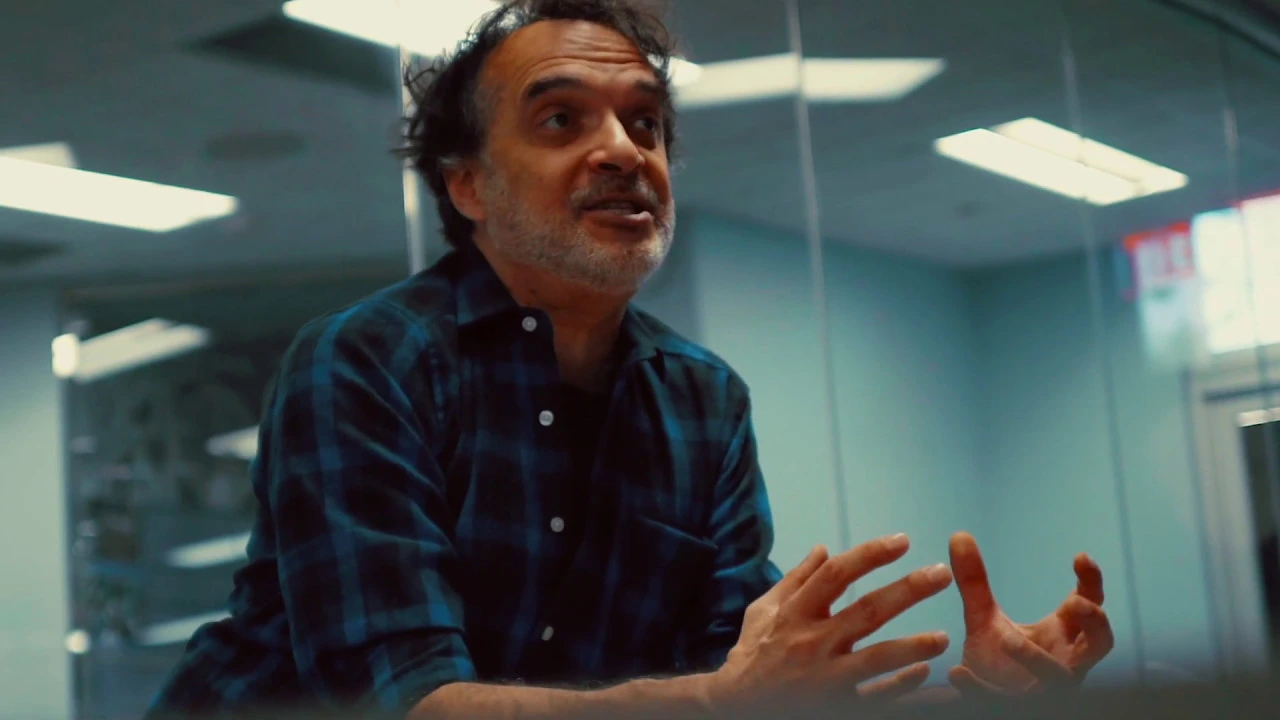
Film I. “Port of Mars,” Interplanetary Initiative.
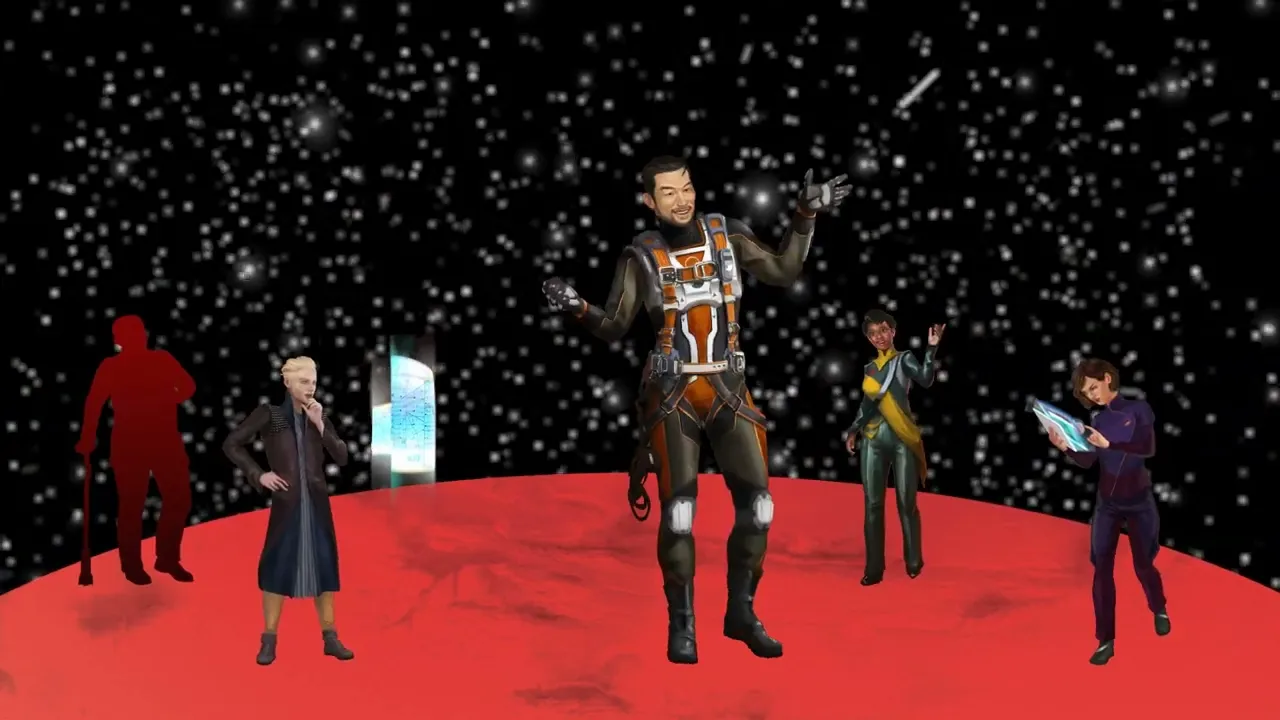
Film II. How to play.

The Researcher’s screen on a game table, beside card decks

Fig. I. The Researcher’s screen.

The Politician’s playmat, with its slots for Influence tokens

Fig. II. The Politician’s playmat.

A player’s hands holding Accomplishment cards

Fig. III. Accomplishment cards.

Poster: a crowd watches a rocket rise toward a red planet; “Getting there is hard. Getting along is harder.”

Fig. IV. Poster: “Getting there is hard.”

Fig. IV. Poster: “Getting there is hard.”

Poster: children peer over a railing beneath a red planet; “Space now open.”

Fig. V. Poster: “Space now open.”

Fig. V. Poster: “Space now open.”

Poster: Earth transforming into Mars; “You look good in red.”

Fig. VI. Poster: “You look good in red.”

Fig. VI. Poster: “You look good in red.”

Publications and press

Publications and press

Credits

Credits

Research

Project Lead

Lance Gharavi

Lead Social Scientist & PI on NSF Grant

Marco Janssen

Social Scientist

John Marty Anderies

Political Scientist

Joshua Thompson

Education Specialists

Brian Nelson, Yi-Chun Hong, Paul Martin

Astrophysicist

Patrick Young

Planetary Scientists

Tanya Harrison, Laura Schaefer, Kevin Hubbard, Andrew Ryan

Space Law

Jonathan Charlton

Consultant

Kim Stanley Robinson

Research Assistants

Skaidra Smith-Heisters, Sechindra Vallury, Lauren Lambert, Emily Curtis, Luis Perez, Dane Whittaker

Design

Lead Game Designer

Michael Yichao

Illustration

Titus Lunter, Suzanne Helmigh

Graphic Design

Liz Leo, Brunella Provvidente

GUI Design

Christina Carrasquilla

Development

Lead Software Developer

Allen Lee

Machine Learning

Michael Simeone

Software Development

Christine Nguyen, Calvin Pritchard, Scott Foster

Programmers

Nick Moran, Lorenzo Faivre

Project Management

Abigail Weibel, Phil Weaver-Stoesz

Administrative Assistant

Caren Burgermeister

St. Bird is a platform of Lance Gharavi.